For Better Learning and Better Living
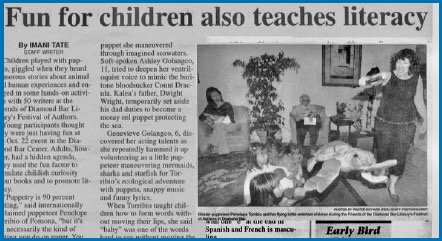
“Penelope’s techniques to reach and teach students of all ages
has been called almost magical, Los Angeles Times.”
Penelope says, “It is not magic, behind every artful activity is specific behavioral objectives, the primary ones are to teach students how to think like a writer, and how to communicate like a writer.
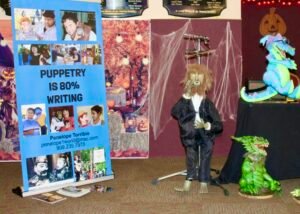
Did you know that puppetry is 80% writing?
Did you know that Directive Drawing can teach writing?”
Did you know that a class imagining a story together can teach writing?
Did you know that songwriting and poetry writing are steps towards thinking like a writer?
Penelope says< That Although I used many artful tools and techniques in my classrooms, preschool through high school, art was never the objective. It just turned out that artful activities were, and are, the most effective tools for reaching and teaching students of all ages. And like me, you don’t have to be an artist to teaching THINK LIKE A WRITER.
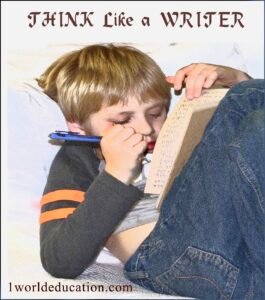
Helping students develop their ability to “Think like a Writer” aims to transform patterns of behavior, change non-beneficial habits of thinking and behavior, and replace these with more beneficial ones, which can be done in many ways.
Hopefully, this site may help parents and educators to develop their own ways of teaching students to
I experimented on what worked and what did not over the years I was in the classroom, and later in my presentations.
My inspiration began in a classroom where I was substitute teaching. It was January. The first thing in the morning, the whole class was to write a paragraph. They were all writing one to two grades ahead of most students their age. The next time I was at school, I found the teacher. Unfortunately, I didn’t write down her name. But the method here was that, from August to December, the students were to create long, long sentences, preferably funny ones. The teacher wrote this sentence on the board. The students didn’t have to, and the teacher didn’t care that the sentence was a run-on sentence. She was working on imagination and inspiration, and creating “A Connected Classroom.”
I earned a credential in special education and a Master’s Degree, with a focus on Behavior Transformation. I used that teacher’s basic technique, modifying it to work in my own classrooms.
In truth all the techniques I separated all fit under this topic, but that would make this web page very long. So I divided into Directive Drawing for Diagnosis, Intervention, and Development, Educational Puppetry, The Connected Classroom, Stories, Music, and Poems.
But here are some techniques I used, based on the teacher’s structure.
Story 1: Spelling Story of the Week
I was hired as the Education Coordinator of a psychiatric hospital. In the mornings, I taught the 5- to 12-year-olds, and in the afternoon, I taught the 13- to 18-year-olds. For teachers who find it challenging to teach in classrooms with a wide range of academic levels, you can see that this issue was built into my classes.
I discovered that group oral writing exercises, with students of great varied academic levels, was actually fun.
I asked each student to select a word from their weekly spelling list. The word needed to be the best word, the most visual, audio, or kinetic work, or a concrete noun. You can already see how much teaching was accomplished just in choosing the right word.
The object of the exercise was to take all these random words and turn them into an exciting story. Considering that all my students were in a hospital environment, you would be amazed at the fun we had.
Here’s one story. There was an eight-year-old boy who literally could not write his own name. However, he contributed some of the most exciting parts of the story, weaving in words from all the different academic levels. Like that other teacher, I wrote the story on a blackboard.
After class, the 8-year-old came up to me and said, “I’m a great writer, aren’t I?”
I answered,” Yes,” and I believed this was true because, for me, writing is not the act of taking a pen and putting words on a page, or even typing them on a computer. It is not forming letters. It is not spelling or grammar, it is imagination, character development, perspective, choice, diagnosis, and the magic of bringing students together on a positive endeavor.”
Story 2
Let me tell you a story from the teen section, where many of the students were brought in in handcuffs. I was surprised to find out how many of these students were writing poetry on their own. They think it is necessarily good, but it was poetry. It could be a basis for getting students to THINK LIKE A WRITER. Here is an example.
A boy was admitted to the hospital. He came in handcuffs. After a day or two he let me read a poem he had written. It showed how angry it was at his mother.
I responded, “This is really good. Would you like to make money from your writing, your poetry, someday?”
He was enthusiastic. I suggested that he write a poem in the voice of his mother. For the rest of the time he was at the hospital, he wrote about ten poems, all about the same situation, but from the voices of all the people around him. Maybe it was Percy Shelly, but I sure that group of poems would be publishable. People want to hear the voices of teens in trouble. I look for some of the poems my student wrote, very poignant.
If something was inappropriate, I would just explain that the people who might buy their poetry were like me, not like their peers. We had a discussion about what was appropriate and how they could change or broaden their perspective.
“Imagination is more important than knowledge” Einstein
“Everything you can imagine is real…it is the preview of life’s coming attraction.” Picasso
“But if we learn to read the signs of life all around us, and if we discover that we are indeed created to be creative, then we can rediscover the power and resourcefulness of imagination — another aspect of soul.” — Marjory Zoet Bankson
I will add some of the student write later. This is a concept page. Think Like A Writer has a major focus on imagination and organizing thought.
“When you help students discover the power of expanded imagination, including their own personal gifts, you change lives.” Penelope Torribio
I want to say a word about creativity. I have people come up to me and say, “I am not creative.”
Literally hundreds of people have said this to be , because I learned to use inspiration, and it manifested as art.
“You’re braver than you believe, stronger than you seem, and smarter than you think.” A.A. Milne, Winnie the Pooh
If you go to About Penelope, you will discover that when I began teaching, I was not an artist in any area. But as I dreamed of ways to reach and teach my students, I discovered the importance of art, and that you don’t have to be best artist to use art to reach and teach.
I hear so many people say that they are not creative. Creativity is imagination manifest.
It is not just painting, or dancing, or singing, or playing an instrument; its primary function is to help one manifest a life. We are all born with imagination. Some people seem to be more imaginative. Maybe it is their life situation, maybe it is health issues. But this I know, imagination and organization of thought can be taught. And when it is part of the school curriculum, you will find students who are happier and more successful. Penelope Torribio
The future belongs to those who believe in the beauty of their dreams.” — Eleanor
Roosevelt
I will be adding more student writing here, so come back to this page, THINK LIKE A WRITER.